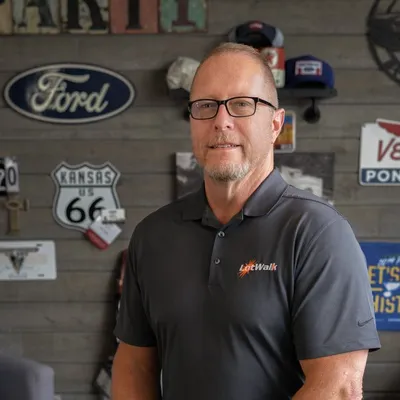
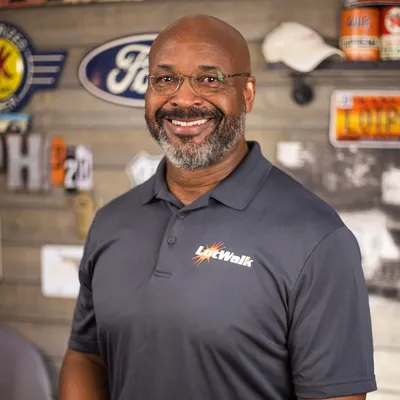
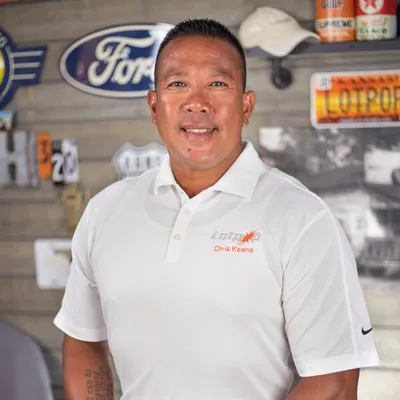
Full video episodes now live on the LotTalk YouTube channel.
Watch on YouTubeDealerships are drowning in tools, not solutions. Guest Brian Benstock of Paragon Honda and Paragon Acura, the number one certified Honda dealer in the world 16 times, sat through a Steve Greenfield presentation showing roughly 500 vendors touching the dealership ecosystem and realized he was paying far too many of them. The data does not flow between products, dealers get charged a toll to access their own data, and managers desk a single deal by jumping screen to screen. His fix at Paragon: fewer partners, zero vendors, where a partner has skin in the game and gets paid on transactions, not impressions. The opportunity is the vehicle exchange, which Benstock calls E equals PO squared because it feeds every profit center at $8,000 to $14,000 per transaction, and with roughly 30 percent of service customers in an equity position, his math puts 900 potential sales a month in Paragon's service lane at just a 10 percent closing ratio.
What you'll walk away with
- Steve Greenfield's slide showed roughly 500 vendors touching the dealership ecosystem. Benstock's reaction: I'm paying far too many of them, and new tools appear weekly asking $1,500 to $2,500 a month to add another point of friction. Paragon's reset: fewer partners, zero vendors, crossing names off the list until two, three, or four remain.
- Your own data should never cost a toll. Dealers are the custodians of customer data they paid to acquire, yet platforms charge monthly fees to move it between products. Benstock's standard for any DMS that locks it up: kick rocks. He wants one integrated hub, an intelligence management system instead of a DMS.
- AI is not going to replace people. People that use AI will replace people that don't. The Harvard quote Benstock builds on: like the carpenter who picked up the electric saw, AI is a force multiplier. He uses it to price cars, arguing nobody knows the market better than the data, and the goal is intelligence in every employee's hand, down to a porter scanning a VIN for an equity position.
- There are 900 sales a month sitting in Paragon's service department. Roughly 30 percent of service customers are in an equity position: same car, similar payment. Benstock's math: 170 service customers, a 10 percent take rate is 17 sales, follow-up converts 10 percent of the missed 153 for 15 more, 32 a day, 900 a month, at a closing ratio he calls terrible.
- The most valuable transaction in the dealership is the vehicle exchange: E = PO squared. An exchange feeds all five profit centers (new, used, finance, service, parts) and pencils at $8,000 to $14,000 in total gross depending on the store. Benstock's challenge: if that is the most valuable transaction, would Automotive News print your plan to get more of them?
Episode chapters
Jump to the part you need. Timestamps match the audio and video.
- 0:00Cold openWho is coming on stage.
- 1:23Introducing Brian BenstockNumber one certified Honda dealer in the world 16 times.
- 3:35The LinkedIn post: 500 vendors, one problemWe don't have a product problem, we have an integration problem.
- 4:44The Elon Musk thought experimentNobody asks Tesla what DMS they run; one integrated system serves the customer.
- 6:40The shopping cart parableSometimes the best redesign of a process is its elimination.
- 11:58AI as a force multiplierThe carpenter and the electric saw, Uber, and five billion photos a day.
- 16:52Partners vs. vendorsSkin in the game: pay for transactions, not impressions.
- 23:00My data, my toll?Dealers as custodians of customer data, and the DMS fee problem.
- 26:00900 sales a month sitting in serviceThe equity-mining math behind Benstock's reset bar at Paragon.
- 29:38It's the payment: the $99 EV leaseHow Woodside, Queens became a national EV sales leader.
- 33:30Master what you have before you switchTiger Woods with Sears clubs, vAuto, Dale Pollak, and AI pricing.
- 39:32E = PO squared: the most valuable transactionThe vehicle exchange feeds all five profit centers.
- 47:08Why not me, why not us, why not now?Benstock on what drives him and the leaders he studies.
- 51:14'I can't get my people to do that' is a you problemLeadership, dehiring, and growing or going.
- 59:18The recapChris's takeaway list, from elimination to frictionless transactions.
The post that started it
Brian Benstock runs Paragon Honda and Paragon Acura in Woodside, Queens, the number one certified Honda dealer in the world 16 times and the number one certified Acura dealer 15 times. The hosts brought him on after a LinkedIn post that hit a nerve: there is a truth in our industry nobody wants to say out loud. We don't have a product problem. We have an integration problem. He had sat through a Steve Greenfield presentation with a slide listing every vendor touching the dealership ecosystem, roughly 500 companies, and realized he was paying far too many of them for far too long, while another dozen tools launch every few weeks asking $1,500 to $2,500 a month each.
His framing device is a thought experiment: imagine asking Elon Musk what DMS or CRM Tesla uses. The question is preposterous because Tesla runs one integrated system. Dealers run a patchwork where data does not flow product to product, partners have disparate objectives, and a manager desks a single deal by hopping screen to screen. Benstock watched one of his own managers do it and decided the answer is not a fourth monitor; it is an integrated hub, what he calls an IMS, an intelligence management system, pulling customer, NHTSA, OEM, and finance data into one place.
The shopping cart parable
Asked by a college professor in 2017 to redesign the shopping cart, Benstock drew two squares and an arrow: the house asks the supermarket to ship the food. The professor said that was not the assignment; Benstock said it was the solution. Days later, Amazon bought Whole Foods. The lesson he applies to the sales process and the vendor stack alike: sometimes the best redesign of a process is its elimination. Start from what you actually need to do, which is give a customer a trade value and a proposal in seconds, not hours.
AI is a force multiplier, not a replacement
Benstock returns to the quote he shared at VinCue Unleashed: AI is not going to replace people. People that use AI will replace people that don't. He calls it empowering because it makes being replaced optional. The carpenter was not replaced by electricity; the carpenter with the electric saw got more powerful. His proof point on ease of use: about five billion photos will be taken today, roughly 92 percent of everything ever shot on conventional film, because Steve Jobs made capturing memories effortless. The dealership version: put intelligence in every employee's hand, so a porter can scan a VIN in the service lane and surface a customer's equity position in seconds instead of routing it through 10 or 15 tools.
900 sales a month sitting in service
Here is the math that has Benstock resetting the bar at Paragon. About 30 percent of service customers are in what he calls an equity position: you can take them out of their current car and into a similar one for around the same payment, upside down or not. People getting hung up on negative equity are, in his words, tripping over dollars picking up pennies. With 170 service customers, a 10 percent take rate is 17 sales. Follow up with the 153 you missed, convert another 10 percent, and that is 15 more: 32 a day, 900 a month, at a closing ratio he calls terrible. The customers already know you, drive your product, and service with you. Go get them.
AI is not going to replace people. People that use AI will replace people that don't.
It's the payment: the $99 EV lease
When Paragon was allocated 100 EVs in metro New York, with apartment towers and nowhere to plug in, Benstock stripped the deal to nothing and tested a $99-a-month lease on a $56,000 truck. The market answered: customers found a place to plug the car. Deals settled around $199 a month on a $53,000 vehicle, and Woodside, Queens became number one or two in the nation in EV sales for both Honda and Acura. The lesson is older than EVs: roughly 90 percent of customers finance, so nobody pays the average transaction price. People shop by price and purchase by payment.
Partners, vendors, and the most valuable transaction
Benstock's standard, borrowed from John Rock of Oldsmobile: show me how you'll pay me and I'll show you what I'll do. A vendor gets paid no matter what; a partner has skin in the game. His ad agency is paid per retail unit sold. His challenge to suppliers: pay for transactions, not impressions, and get me fewer impressions and more sales. He also pushed two of his providers, VinCue and Team Velocity, to integrate for the sake of their client, with results he teased for later this spring.
For the dealer wondering where to start, his drill is the question he runs through his managers: what is the most valuable transaction in the dealership? The answer is the vehicle exchange, E equals PO squared, an exchange equals a profit opportunity squared. New car gross front and back, the used car you took in and retailed, the repair orders on both, and the certified products: $8,000 at some stores, $14,000 at others, feeding all five profit centers. If that is your most valuable transaction, what does your plan to get more of them look like, and would Automotive News print it on the cover?
The leadership section dealers needed to hear
When Renaldo raised the complaint the hosts hear daily, 'I can't get my people to do this,' Benstock did not soften it: that is a you problem. Introduce me to the guy who can; I thought your name was on the building. He is up at 4:00 a.m. sending reports and giving his team a kick in the backside, and his inner circle is built on people like Rod Deljanin and White Plains Honda partner Jason Graziano, who took a Westchester store from sixth in the district to number one and top 50 in the country. On the hardest call, dehiring, he quotes Jim Rohn: you have to pull the weeds out of the garden or they'll take the garden. You've got to be growing or you've got to be going.
The Monday-morning action plan
What to take from Benstock's playbook this week:
- Count your tabs. List every tool your team touches to desk one deal. Anything that does not move a transaction forward goes on the strip-back list.
- Ask the data question. Find out what you pay to access or move your own customer data between platforms. If the answer is a toll, start the renegotiation.
- Mine the service lane. Pull the roughly 30 percent of service customers in an equity position and make the offer: same car or better, similar payment. Run Benstock's 10 percent math on your own RO count.
- Master before you switch. Tiger Woods wins with Sears clubs. Squeeze full value from the tools you have before chasing the next one; the nuances between vendors only matter at full efficiency.
- Define your most valuable transaction. Put a dollar figure on the vehicle exchange at your store, then write the step-by-step plan to get more of them. Pair it with a real used car inventory management process so the trades you trap actually turn.
- Retire 'I can't get my people to.' It is a leadership problem, not a people problem. Set the standard, tell rather than ask, and pull the weeds before they take the garden.
Get insights like this every week
Join the Insider Newsletter. Inventory tactics, podcast recaps, and dealer strategies. No fluff.
Transcript is auto-generated from the episode recording and lightly formatted. It may contain transcription errors.
Chris Keene (00:00): In this week's episode, we find out what made Chris say this, who we're about to bring on stage. I would arguably say one of the best disruptors in our industry today. One of the most sought after people that is a speaker across the world.
Chris Keene (00:23): And here we go, folks. We are back. We are in full force. We got brother Anderson back. You got Mr. Leonard. I'm Chris Keene, one of the co-hosts. You've tuned in to Lot Talk powered by LotPop. Gentlemen, we got a day, but we got to pay some homage. We got to pay some love. We got to pay some respect. Mr. Anderson, glad you're back, brother. We missed you.
John Anderson (00:44): Well, it's good to be back. Trust me. So, I appreciate that. It's It's good to be back in the chair. And I'm fired up and I'm ready to go because we got a we got a big big big one today. So, yeah. Yeah.
Chris Keene (00:57): Huge. It's huge. Although it's huge. It's huge.
Renaldo Leonard (01:01): It's I'm I was just happy that Peepot didn't come walking into the room with somebody's ear in his hand. Uh yelling Who's here? Who's your baby? Come on. Who Who's your congratulations?
John Anderson (01:15): No. Hey, listen. I'm fortunate that I remember it. You know, it was a few days ago. I'm fortunate I remember it.
Chris Keene (01:23): Lord have mercy. Here we go. Fantastic. Listen, viewers and listeners, you're going to want to watch this from right now to the very, very end because who we're about to bring on stage, a business leader, a thought leader, I would arguably say one of the best disruptors in our industry today, one of the most sought after people that is a speaker across the world. And he's one of you. He's a dealer. The number one certified Honda dealer in the world 16 times. The number one certified Acura dealer in the world 15 times. The man runs marathons. He works out like crazy. Guess what, gentlemen? I took some note on that because the best form of flattery. What is it, gentlemen? Is it duplication?
John Anderson (02:10): Absolutely.
Renaldo Leonard (02:12): Yes, true.
Chris Keene (02:14): And I wouldn't mind duplicating this gentleman we're going to bring on stage. So, without further ado, I want to bring him on stage. Brett, let's throw the man, the myth, the legend out there, Mr. Brian Benstock. Sir, welcome to the show.
Brian Benstock (02:30): Thanks for having me. What an introduction. I'm I'm done. I'm going to check out now.
Renaldo Leonard (02:37): You're just lucky. He was a little crushed for time. So, yeah, his introductions usually go about seven, eight minutes, but he definitely covered all the bases.
Brian Benstock (02:48): I I don't have that long a resume, but thanks anyhow. I appreciate it.
Chris Keene (02:53): Yes, sir. You got a pretty healthy one. It's not bad. You know, Brian, thank you, you know, for taking the time and respectfully. We know that you're operating two very successful dealerships up there in New York and you're pulled 55 million different directions and for you to take time and join us today, it literally it's a treat for us. But I want to get into the context of why, you know, I reached out to you and said, "Brother, we got to hear some insights." you know, we got to hear some insights from you about a post you put out there. I don't know, it was probably a week ago. And I'm gonna read part of it for the viewers and the listeners that might have not seen it. But if you want to read the full post, viewers and listeners, jump on LinkedIn, go find Brian Benstock. Damn sure connect with them because he's got some amazing content he puts out there that gives back to our automotive community. Some of it you may not like and it'll piss you off, but guess what? That means he's probably reaching you and you probably need to make a change. But I want to read this. Brian, you said there's a truth in our industry that nobody wants to say out loud. Well, number one, we're going to give a big platform here for us to say this out loud. You said, "We don't have a product problem. We have an integration problem." You sat through a presentation recently with Steve Greenfield where he put a slide listing every vendor touching the dealership's ecosystem, 500 companies. Then you went on to say, I looked at the board and thought I'm paying every one of them. That's a problem. I'm going to stop there, Brian.
Brian Benstock (04:30): Well, thankfully, I'm not paying I'm not paying every one of them, but I'm I was I am and was paying far too many of them for far too long. Sure.
Chris Keene (04:40): So, unpack that. That's a problem.
Brian Benstock (04:44): Absolutely. You know, I have this um great imagination and this vision, this story. I'm picturing I'm sitting at my favorite restaurant having a glass of wine and recapping the day. And in walks Elon Musk and Mr. Musk sits down next to me and to my surprise, he knows who I am. And he says, "Hey, how's it going, Brian?" I said, "Hey, Mr. Musk, how's it going?" And I asked him a simple question. I said I asked him, "What DMS are you using?" And he looks at me like I'm crazy, right? And I ask him, "What CRM are you using over there at Tesla?" And he looks at me like I'm crazy. It would be preposterous, right? Because we know beyond a shadow of a doubt what they're using there is one integrated system where a customer has entered into that system and it gives them everything that's Tesla. And in our industry, it's not uncommon to say, "What is the DMS system that you're using? What is the CRM system that you're using? what is the data mining tool that you're using? And all of these tools are put together in the hope that we can better serve and better solve the difficulties of our clients. The challenge there is that the data doesn't flow easily from product to product. There's no seamless integration and and and quite often data our data is locked. Quite often we're charged a toll to access our data. Quite often the the partners that are supposed to serve the dealers have disparate objectives and and having those disparate objectives there's friction, there's loss of trans uh transparency and of course there's inefficiencies. There's no shortage of products or tools. And probably since Steve's presentation, which was about two weeks ago, uh there's probably another dozen or so new products there, looking for $1,500 to $2,500 a month month to solve a problem that is um just another point of friction for the customer, another point of friction for the dealership.
Chris Keene (06:37): So, how do we combat this?
Brian Benstock (06:40): Well, you know, I I think I've got a pretty good voice with the vendor partners that we do business with, and I really asked I asked a couple of them to get together for the sake of their client, Paragon, to solve the problem for us. I I sat and watched, we have a young manager, Patrick, and he's a really good guy. He worked with us for many years. I watched him desking a deal, and I mean, my lord, you go through that process, and he was going from screen to screen, from product to product to do what? to sell a single car. And I use this story. It's a It's a pretty interesting story. I had the occasion during COVID to go uh food shopping and I it's not something I normally do. I go to a supermarket and I I realize you have to go through every aisle to get what you need. They're smart. They don't put everything you're probably likely to buy in one aisle. They want you to walk through every aisle. And can we go through this together? You walk through the aisles and what do you do? You load up the shopping cart. You go from aisle to aisle putting the items that you want uh into the shopping cart. Then what do you do? You go to checkout. And then what do you do after that? You unload the shopping cart and put it on that conveyor belt. Then what do you do? You pay. Then what do you do? You reload the shopping cart. Then what do you do? You go out to your car. Then what do you do? You unload the shopping cart. Then what do you do? You drive home. Then what do you do? You unload the car. uh as a sort of a a project with a college professor. He had asked us in the class to redesign the shopping cart and I drew two two squares with an arrow going from one to the other. You know, many of the other groups that were drawing drew out this beautiful new version of the shopping cart. And when I when I gave this uh drawing to the professor, he looked at he goes, "What what the heck is this?" And I said, "Well, it's a redesign of the shopping cart." He goes, "I don't get it." Well, I said, "Well, one is your house and the other is a supermarket. And wouldn't it be great if we could just the house could ask the supermarket to ship the food directly to our homes and eliminate the whole process." This wasn't excuse me, this wasn't during COVID, it was pre-COVID. It was 2017. And the professor said, "But that wasn't the assignment." And I said, "But it is the solution." And he said, "I don't think so." As luck would have it, three days later, Amazon bought Whole Foods. So, whatever year Amazon bought Whole Foods, whatever month that was 2 or 3 days after I I drew this shopping cart, I'm not claiming to have created or invented anything, but I said perhaps the best redesign of the shopping cart is its elimination. And I think that's that parable is very true for perhaps a redesign of the sales process, perhaps a redesign of the vendor equation. Let's eliminate it and start with what is it we actually need to do. And what we need to do is to be able to quickly give the customer value on their trade and and a proposal on the potential vehicle or vehicles that they're looking for. And shouldn't we be able to do this in a matter of seconds, not in the amount of time it's taking our team. And it's taking our team longer because of the lack of integration between these quote unquote partners that don't play nice together. And I watch him. So, so the solution for us seemed to be we've got two or three screens and they have one window with one set of vendors on it and another window with and I could see where does this go 10 years from now you got 20 screens around you or wouldn't it be great if we had one single integrated hub that took all the information that we have available on the customer all the information available from NHTSA all the information that we have from the OEM all the information that we have from the OEM finance sources put it into an integrated hub and created instead of a DMS, an IMS, an intelligence management system where we could get all that information to solve and serve the customer in one spot. And I think that's the the drive for us and that's what we're looking to do.
Chris Keene (10:38): You know, I was at VinCue Unleashed and I heard you speak around some of those topics right there.
Brian Benstock (10:46): It was a good event, wasn't it?
Chris Keene (10:48): Oh, it was great. you know, in all my years, and I said this publicly, you know, I worked, you know, for the other, you know, big software company for 10 years, and they had a lot of really good events, and they had some good event planners and things of that nature, and they put on some really good speakers, etc. But in all my years uh on this side of the industry for the last now almost 14 years, I've never been to an event as collaborative, educational, thought-provoking as that VinCue Unleashed event. So yeah, it was a great event, you know, and I want to turn the mic here in a second over to John or Ronaldo, but you said something because in speaking of all these different platforms, but at that event, and what made me think about is you just talked about some AI. Okay. In that event, you talked about and you quoted a Harvard professor about AI and humans and everything else. I know the quote and I think I even shared it on our podcast not too terribly long ago, but will you speak to that again?
Brian Benstock (11:50): And are we talking about AI will not replace people? That quote.
Chris Keene (11:55): Yes. Yes, sir.
Brian Benstock (11:58): So yeah, the quote is AI is not going to replace people. People that use AI will replace people that don't. you know that when when I first heard that it was profound and it's it it was quite a while back you know and it was a relief because that that makes it optional for someone to be replaced by AI right if you can use AI you can not only maintain what you're doing but you can accelerate it uh and and I think that's really the upside of the story so to me I I thought that was empowering that that statement
Chris Keene (12:32): man that's strong that's strong
Brian Benstock (12:35): and you know and I I'd ask that we take a look at other inventions like electricity uh and you know and and and what what happened there, right? Did the carpenter who's using a hand saw get replaced by electricity? No. He or she became much more powerful with this new electric saw. They're able to do much more. And I would think that if you stayed with the old ways that you would be at a a distinct disadvantage when it came to competing with this new technology that's out there. I think the same thing has happened over and over again. Right? Take a look at Uber coming in. Many taxi drivers and medallion owners went out of business. Other people grew their business exponentially by using ride share and mastering ride share and the opportunities to serve customers better, quicker, faster. And so I I think the same thing exists with AI. I think AI can really be a force multiplier for many of us. But there's no tolerance in that system for the interruptions in going from screen to screen. It's got to be have flow to it. It's got to make it easy. And I think in that meeting that you were at, we use the example of the camera and you look at what did Steve Jobs do you know among other things this iPhone and in essence he turned every one of us into a photographer and as a result but by how did he do it by making it easier and again we went through the shopping cart example. If you went through an example of developing film, let's say 20 years ago, taking a 35mm camera, taking 36 pictures, rewinding the uh the film canister, taking the canister out, driving it to the photo mat place, dropping that off, waiting five days, coming back, getting the pictures, then needing enlargements. You look at that process compared to being able to just simply go out and take a thousand pictures in a second. And I think the the math and the data is pretty compelling. More pictures will be taken today. Approximately five billion pictures will be taken today, which is roughly 92% of all the photographs ever taken with conventional film photography. Let me say that again. You got a hundred years worth of photographs is being outnumbered by the amount of photographs being taken in a simple day. And is there not a lesson there for us? If we make it easier for people to do business, they'll do much more business. And I think the evidence is pretty clear. Kodak uh didn't quite understand the business that they were in. They thought that they were in the print photography, film photography, and developing business. That's how they make their money, but that's not the business that they were in. The business that they were in is capturing memories, right, with photographs. And Steve Jobs happened to do that better than everybody else. He just made it really easy to capture those memories and to send them all around the world. I believe what how profound is it if we can put intelligence in everybody's hand? Won't that be phenomenal? And is it possible by doing so we can increase the amount of business we do at scale like we could never dream of, right? by having every single person in the dealership be able to scan a VIN and to be be able to give a customer an equity position on their car. Wouldn't that be incredible? And not to have that process back and forth take 10 minutes, have to go through 10 or 15 tools, but to be able to do that with a simple barcode scan to give them their equity position and what that means in terms of their ability to get out of that current car and into the most likely other replacement car. It could be the same car or a car below that car or a car above that car. What if we could do that in in seconds? Would we do could we do uh multiples of business we're doing now?
Chris Keene (16:23): Anderson, I know you have I know you guys have I see you over there taking notes and I know you've read that post 30 times, man.
John Anderson (16:32): I I you know, listen, Brian's I mean I feel like I'm sitting in church right now. You know, look,
Brian Benstock (16:39): don't mean to preach. Tell me to preach.
John Anderson (16:42): You brother, you already you're on the pulpit, man. You're preaching. You're open.
Brian Benstock (16:47): Believe or believe in. I believe what I'm saying is true.
John Anderson (16:52): Exactly. Right. Preach, baby. I So, while Brian was talking, I'm thinking about, you know, he's bringing up these company examples. I'm thinking about Blockbuster and Blockbuster and Netflix, right? It's it's it's looking at a situation and and removing all the obstacles, right? And before we came on, I'm
Brian Benstock (17:11): John. Yeah. Think of that. You just hit another one. Blockbuster that we've all been to. You go there, you're dressed like crap. You pray nobody sees you. You got a baseball cap on. You go in there and you're standing in front of empty cartridges and you pick an empty cartridge and you go up to the front of the line. They go find the actual cassette tape. They put it in there and Oh my god. And they even offer you some goodies and stuff and you just compare that with uh the remote sitting at home with Netflix.
John Anderson (17:42): Yep. Come on. You know, it's, you know, before we came before we came on, I mentioned to Brian, you know, I remember my days work in a sales desk and I could remember exactly what he was talking about in in his in his article on LinkedIn talking about I watched one of my employees go through that used to be that used to drive me crazy, right? I I had to do and here, listen, this is what's this is what's so ironic about what we're talking about today cuz we don't like referring we like referring ourselves to a dealer partner, right? But we are in this category, right? So, so we're one of those tabs, but I've always I've always tried to I've always tried to look at that from a from a manager's perspective in a dealership, right? How many times do you have to go back and forth to get your job done? So, I love the fact that, you know, Brian has thrown this out here of, man, we've got to do a better job of smoothing this out. And to your point, Brian, and in in your write up, you mentioned, and I'm I'm interested in your comment on this, at Paragon, we're stopping the system. We're stripping the system back to what actually matters. And the first two things you mentioned was fewer partners, zero vendors. So, I want to I want to throw that out at you. What in your in your viewpoint, what constitutes a partner to you versus a vendor? Because there are differences, but I'm interested to hear your take on that.
Brian Benstock (19:04): Well, you know, that's it. There's John Rock of Oldsmobile fame said, "Show me how you'll pay me and I'll show you what I'll do." And so vendors have to have skin in the game for too too long. The vendors uh get paid no matter what. Like it's an attorney. They get paid win or lose, right? And I want to have something where if we're not doing well, the vendor gets paid less. And if we're doing really well, they get paid more. In essence, a partnership or an alliance. And you know, you got to be careful saying partnership. I'm not partners with these guys, but like our ad agency. Our ad agency gets paid per unit sold, per retail unit sold. So, they got some skin in the game. If we're not selling cars, they're not getting the same fee. Why just pay 15% or whatever the percentage is that people are paying today on top of everything. We're going to pay, you know, show me how you'll pay me and I'll show you what I'll do. So, if we're going to pay them for transactions, we're going to have more transactions. That's what I want. I think the same that to me is the differentiator uh between vendors and partners because most vendors are not interested in that arrangement. They want to get paid no matter what and partners say hey I hey this could be really great if we put our efforts our shoulders behind you guys and help you guys do more business and it's quantifiable then we should get a little bit more and we're happy to pay a little bit more. What would you pay more for leads or transactions? you know, well, what about impressions? I love that term. We got you 10 million impressions. That's great. How many cars are we sell? How many cars we sell? Get me less impressions. I want more sales. And we'll we'll all pay more for transactions. I think I certainly will. So, I think that's the difference. And we got to test who's really with us, you know, because I asked uh one company, I said, "Hey, I I need you. You guys specialize in this. You guys are the appraisal tool. You have the best information, I think, to make an educated decision in our market what a car is worth. And you guys have the best data mining tool, and I need you guys to work together. You're in no danger of figuring out the other guy's business. But tear, you know, like Ronald Reagan said to Gorbachev, tear down this wall, Gorbachev, tear tear down these walls. And there's a certain amount of trust that the companies had to have. And I I said, "If you do that, I there's probably more than just me that would be interested in this." And I first started going I went to VinCue first and said, "Here's the challenge. Here's what I want to do." And uh the team there said, "We can do that." And they got back to me about 10 days later and said, "We need this component to it." Then I went to uh Team Velocity and said, "Hey, can you give these guys a call? I think they've got some good stuff." Um, you know, I think the guys were playing with the cards close to their chest for a little while, but I think both heads of the companies had a bigger vision. They saw that this is a industry-wide problem that perhaps if they solved, they can have more than their fair share of dealers sign on. And I'm really not concerned so much with that. I'm concerned about our dealership. And this specifically was around sales and service and what it takes to really have a meaningful impact on that service department. I I think you're going to see some really spectacular things coming out of Paragon February, March, April as we um look at integration to solve um pretty big opportunity for us.
Chris Keene (22:16): That sounds like a tease to me. Yeah, that sounds like a tease to me.
Renaldo Leonard (22:21): One one of the things that that that jumped out at me about what you posted was the fact that you feel like you need to protect the customer, protect the team. And I've always been a proponent of the fact that we've got internal customers and external customers. Removing that friction from those information systems in order to be able to to generate the experience that you've alluded to. At what point do you have to make a decision on your internal customer or your external customer taking priority over what you're looking for and looking to remove from both your partners and your your vendors?
Brian Benstock (23:00): Well, you know, I I I live by the adage if it's uh doing what's right for the customer will always end up being what's right for for us, right? And you don't I think too many I think that's one of the challenge for the vendors. They're always trying to do what's best for their company and it's not necessarily what's best for the customer and it burns them. I I think Kodak's the same example. You know, I I understand they had the digital technology before anybody else, but they said, "No, no, no. We're in this business. This is how we make our money. We want to protect them." They weren't as interested from my perspective in what's best for the customer. And obviously going through that long process of dropping off film, waiting 5 days today. Someone said, "I I'm a marathon runner." And I I was and and somewhat am. And you cross the finish line, you get back to your You want to see the pictures from the event. You want them now. We're in a now business. I can't think of waiting for somebody to bring a cassette or a film canister and waiting a week or two weeks or three weeks. You want that information now. And I think the information is coming so quickly at us today that we have to adjust. The challenge for me is I'm the guy that set up that system that they're using out there. They're doing all the things I wanted because what was important to us, to me, getting the data. So, they'd have to enter the information into one platform and then they'd have to transfer that information over to another platform and push it and maybe that other platform is going to charge a fee for your own data. I want to use my data. Well, you got to pay the toll. What? And um whether it's a monthly toll, it's a weekly toll, it's my freaking data. I want my data. Data is the edge that the customers that we have today over the Googles and the Amazons and everybody else. We have that PII. And we've got to be able to access it. And we've got to be able to access it cleanly, quickly, and uh without fear of that information, that data being compromised. And and so if you're a DMS provider and you can't do that for me, kick rocks. You know, it's that's our data. We're we're paying you a a a king's ransom for that. And then you're going to charge us fees on top of that. And then that the firewalls in between these companies to protect us. We have to charge you what? No, you have to protect us and not charge us extra on top of that every time.
Chris Keene (25:20): It pisses me off because here's the thing. I mean, we we we talk about it's our data. Yes, it is. So, Mr. Mrs. DMS company, it is our data. Here's the biggest key that they forget. They didn't pay for to get that data. You paid to get that data.
Brian Benstock (25:42): And listen, I'm going to we're probably going to hear from some really sharp cats in your audience that are going to say the customer's data is the customers. It's true. It is the customer's data and we are the custodians of that data but we have access to that data to better serve the customers. We've not subrogated that right to the DMS CRM and everybody else that we we should be able to access the data and be very mindful of how we use that data. But we we should be able to use that data to to quickly assist the customer. Could you imagine? You've got a a porter scanning in a car in a service lane and he scans in the car and he scans it and all of a sudden a a prompt goes off. Show me the money and and the porter says, "Hey boss, I got one. I got one." And and what do you mean by that? Who's got a customer that's in equity you could take out of their current car, put into a new car, and lower their monthly payment. And what if you had about 30% of your customers in equity in service every month? And that's the data that we have that shows about 30% of the people I use the term in equity. It's probably not an accurate term. Use whatever definition you want. My definition of in equity is we could take them out of their current car, put them into a similar car for around the same payment. I don't care if they're upside down or not upside down. People getting so hung up on that crap right now that they're tripping over dollars picking up pennies.
Chris Keene (27:14): Thank you. Preach. Preach. Yeah.
Brian Benstock (27:18): If you ask somebody, and I did this a th a a thousand times. You go to an audience, and I'm blessed to be able to speak. I'm not a public speaker. I'm a car guy, but I do some speaking. And when you go up to 10 people in an audience and you say, I I can What kind of car are you driving? They give you BMW X5. Okay. If I can take you out of that current X, get you the brand new one and keep your payment about the same. Are you interested? And maybe you'll get a no. And maybe the next guy will say no. But you can't get through 10 people without at least one of them saying, "I'll do that." And if you can if you can approach uh a 100% of your customers and get a 10% take rate, do you know what that looks like in a store the size of Paragon? Well, I I do. I'll give you the math. We have about 170 service customers a month. 10% first blush would be 17 sales a day. A day, right? But there's more. Let's just say of the 170 you sold to 17, you've got 153 customers that you missed. Well, is it possible that going through and following up with those 153, you could coach, persuade, convince another 10% to say, you know, I'll do that. I'll do that. Yeah, I'll definitely do that. That's another 15 sales. So 15 plus 17 would be 32 sales a day. 30-day month, that's 900 sales a month. That's at a 10% closing ratio, which is terrible. 10% of customers that know and service with you drive your product that you're making an offer to to get out of their current car, get into a new car, and keep their payment about the same. And so today, I believe we have the technology and the integration to do that. And and so I'm resetting the bar at Paragon and my guys are not real happy with me. I'm saying there's 900 a month sitting in the service department. 900 sales a month sitting in service. Go get them. Go get them. They think they think I'm crazy, which is great.
Chris Keene (29:20): But you know, Brian, you bring up something and you know, especially for old people on the call, you know, I haven't been in the business as long as him, but since 1994, this is what I've been taught. People shop by price, they purchase by payment. And that's exactly what you just talked about.
Brian Benstock (29:38): Well, yeah. I I didn't want, you know, I I hear all these Oh, man. I'm going to be rude. All these idiots affordability. The average price of a car is 53,000. Well, you're not selling the average price. You're never selling. What percentage of customers finance? It's about 90% forever. So, who's paying $53,000 for a car? Nobody. It's the monthly payment. We have an affordability problem because we had interest rates go up. We have an affordability problem because the OEM started during COVID making only the most expensive cars. And so now we we've got to bring it back. It's the price. It's the price. It's the price. And I still think uh today's vehicles offer incredible value. You know, we had a a real concern here in Woodside, Queens when we were given uh 100 uh EVs to sell at Paragon. There's no place to plug them. We're in we're in metro New York, right? There's no no place to plug. We got apartment buildings mile high, no part, no garages with these chargers. And I was concerned that we wouldn't be able to uh sell the vehicles. Well, what did we do? We came out with a spectacular lease that was unbeatable in the marketplace. And we said, "Let's see if we can sell these at $99 a month. Let's see if the market's there." Sure enough. Sure enough, the market was there. The car, the truck was a $56,000 truck. I didn't talk about $56. $99. And you know what? For $99 a month, you know what the customers did? They found a place to plug the car.
John Anderson (31:12): They figured that out real quick.
Brian Benstock (31:15): So, so you know, and EVs are not for everybody. Uh, but and it was an experiment. And, you know, it was one of those we stripped out everything where we make nothing. Let's see. Let's see is there a de can we create some demand? and we were able to create some demand and and by the time customers figured out what what they wanted to put down. It wasn't quite as much as he had called for, we ended up with a payment that was about $199 a month for $53,000 and the customers thought it was a great value. And we were like number one or number two in the nation in EV sales for both Honda and Paragon Acura here in Queens, New York. No, not the cons conservationalists in Oregon. not the wheat eating guys out in California, Woodside, New York, was selling more EVs than anybody else because we had a plan. We had a process and we figured out, you know, it's the price, the payment, dummy. It's the payment. And uh, you know, I I think those are really great lessons for us when we pay attention to what's best for the customer. And um, there are there are dealerships in the market that just said, "Hey, you know, I don't want these cars. I'm not going to take these cars. They're not going to sell." And I think they missed a big opportunity. Again, respectfully, dealers have the right to stock and sell what they think is best, but you know, I think Honda was relying on us to be a little bit of a lighthouse dealer, and we said, "Let's see if we can do it with EVs." And we did.
Chris Keene (32:30): I have two questions, but one of them I want to save toward the end, and it's a million-dollar question we've asked every dealer, principal, general manager that's ever been on our show with us, and it's about your people. But I'm going ask that one at the end. book one around this same thing John was talking about a minute ago where he asked you about the top two where you were talking about stripping the system back to what actually matters. When you talk about no duplication, how are you determining because you you could look at multiple different solution offerings, if you will, that one provider does that another provider does, another provider does, and they're three different offerings, but it almost seems like on some of these, this one doesn't have everything you need, that one doesn't have everything you need, and that one doesn't have everything you need, but you really need something from all three of those. But still, how do you determine what to strip back?
Brian Benstock (33:30): Well, first of all, it only makes a difference if you're running at full efficiency. You know, it's if um if Tiger Woods went to Sears and bought Sears and Roebuck golf clubs and I had the best golf clubs in the world, I'm in no danger of beating him, you know. And so the the those nuances between one vendor and another. I'm not saying all vendors are alike, you know, take take the vendor that you've got and master what you're doing. And before you start looking for another vendor because, you know, if you're not going to master one, then the other vendor is probably not going to be a big help for you. But when you do get to that mastery level, then those little nuances for your store and for your market and for your team become very, very important. You know, I know what we want. I like to stick with uh vendors. We had the same ad agency for gosh 15 years. We were with uh vAuto for, you know, since their inception. Made a switch recently. Uh that was really more about the uh Dale Pollak resigning than anything else. I mean, Dale was Dale to me is vAuto, will always be vAuto. He's it's just a genius, you know, there's not there's none smarter. Dale is I consider him a friend and I I would not have made that switch until Dale had resigned. You know, he's uh he's my my rabbi and put me on the map when it came to used cars. Uh but but you know, I learned a lot uh and that what what's important in used cars. What do we want to do? We want to have access to data. I think that they were a little slow on some of the AI initiatives, right? I um you don't need a person to price your cars. You can use AI to price your cars. You have to feed the AI the information you want. And there's somebody in the audience who say, "Yeah, but I know the market better." No, you don't. No, you don't. You may have those aberrations. That's that one car, that one setup, that one age that you're going to get a little bit of extra money above and beyond. How about we sell the cars for market value? How about we sell them for slightly under market value and own the market value? Let's get that turn going in the dealership. And I think AI can help us along along those lines. In addition, who has my data? Who is managing customer behavior? And we have a a team that does that at Apollo at Team Velocity I think right now does it better than anybody else. We get to see the customer journey from stem to stern. And so I I think those two being able to integrate the first integration I've ever seen like that. And some of the other big DMS players have purchased each of the components and they have them under their portfolio. Yet after x amount of years they're still not playing nice together for whatever reason. And who suffers? The customers suffer. There's a guy over at CDK, Mike Stahl, and Mike's a really, really good guy. And we were working on some workflows, and Mike took a folder, and he said, "Okay, I'm a folder. Let me follow this folder through the dealership." And I thought it was a really great way to learn the hideous processes that were in place at the time. And it's funny, my partner Michelle Singer, she's a veterinarian, and she said when she was going to veterinarian school, she had to be a red corpuscle or white corpuscle and pretend going through the the body to see what the functions were. And she said it was a really great way of learning the functions. Well, I when you looked at what happened to a folder at this dealership, it was as ridiculous as the film example, as ridiculous as Blockbuster, as ridiculous market. That folder went everywhere. And what did that have to do with the customer journey? Nothing. What What benefit did all those different pit stops that that folder makes? How did that help the customer? Not at all. So, we we really tried to streamline that. And one last example uh they say when Apple was in deep weeds uh and Steve Jobs came back they they had 140 products being sold all over the world and as the story goes he told them all the managers to cut that down to 10 and they oh we can't do it we can't do it we can't do it we said well then you're going to be fired okay they did it they cut it down to 10 10 products and I believe he told them now cut it down from 10 to four it may be six I'm not I don't remember I think she's 10 and they they went to the core products and they got rid of all the waste and all of a sudden that's where Apple was able to grow from the $900 million company to the $3 trillion company that it represents now. So less is more quite often less is more and we're we're working on uh Steve Greenfield's hit list up there. We're going to one by one, we're going to cross out those 500 vendors till we get down to the meaningful two or three or four that we need to operate our business.
Chris Keene (38:05): John, you look like you got something. You look like you got something you want to unpack with.
John Anderson (38:10): No, I I I'm just I'm enjoying every bit of this. I You know, I Brian Malcolm Gladwell, Outliers. Have you read that book?
Brian Benstock (38:20): I have.
John Anderson (38:22): Without a doubt. Right. You're an outlier. So I let me let me ask you this question cuz for the dealers that are watching this and I look one of my frustrating things that I go through uh on my side now as a part of the as opposed to the dealer side is the word I can't I can't I can't get my people to do that. I can't get this done. I can't get that done. Right. It drives me it drives me freaking insane. Uh so you you've talked about a lot this morning and especially addressing the article that you wrote and what we've asked you and so um what I would for the for for a dealer out there that's listening to this and having same the same struggle in their store. What would you say to them from a perspective of where they should start? Right. you've got such a good grasp on this and and you're leading this charge and and you know, for lack of better terminology, you're sitting at the mastermind table. A lot of these guys aren't, right? A lot of these guys are trying to figure out how I can get through the day to just get my people to call my freaking customers, right? You know, for that average guy out there that's trying to that really wants to improve and and and what you're saying is resonating, what would you tell them to start on their path?
Brian Benstock (39:32): Well, I you know I I without knowing what the dealership's difficulties are, it's it's difficult to answer that, but I I'd say you know where do you start? You start right where you are with what you've got. You start now and you start today. I like to run a drill through my managers. What's your most valuable transaction in the dealership? And they'll say it's a finance or they'll say no, no, what's holistically, what's the most valuable transaction in the dealership? Let's quantify that by putting a dollar amount. What's the front end gross? What's the back end gross? And then let's find out how we can get more of those. And for us, and I think for most dealers, the most valuable transaction is a vehicle exchange. The customer that's driving your car, servicing with you, comes out of that car and gets a new car. When you when you put that together, the value of the new car transaction, the value of the used car transaction, the repair order for the new car, the repair order for the service for the used car, and you take a look at that, you you and you put the upfront gross, the back end gross, the upfront gross, the back end gross, and the repair order on a certified car, you come up with a number. And some dealerships that numbers $8,000, and some it's 14,000. Now, I'm saying that when you add the total new car gross on the sale, front, back, whole back, and total used car sale when you sell that used car that you took in from that customer and the order and we call it E equals PO squared. You know, an exchange equals a profit opportunity squared. And what I really love about that transaction, gentlemen, is that it feeds all the profit centers in your dealership. Feed the new car department, the used car department, the finance department, service department, parts department. And and so I think that's one of the maximum ways to profitability. If one transaction feeds all five profit centers and there are other subprofit centers and it feeds a couple of them multiple times like the finance department, service department, parts department, then then that's really good for the dealership's overall profitability. In addition to that, it's really good for the OEM's profitability because they get to sell a new car. They get to sell a used car of their brand. So two more UIOs. They get to sell a bucket of their parts. They get to sell, we believe in using Honda's products for VSC and other and for maintenance. We think that's really good, you know, for the team. Um, but they get so you get to sell those products that also have retention qualities to bring the customer back in. And we think that's a very important transaction. If that's an important transaction, if that's the most important transaction, what does your plan look like to go out and get more of those? Would Automotive News be excited to print your plan on the cover? Hey, this is John Smith's plan for increasing the profitability of his dealership. Here's a step-by-step way that you can start today. And if not, then you have to ask yourself, why not? And what can we do to do that? And so, I would ask the dealer always to start with right where you are with the existing customers. Everybody's got a service department. Most everybody has customers in that department that are in equity. And let's just start talking to them.
Renaldo Leonard (42:38): And a followup to that, Brian, when it comes to the smooth and seamless working partners within your store that you're dealing with, do is it do you feel like it's more important to focus on what's happening with us internally as a dealer so that we understand the foundation of who we are and what our identity is as a dealer and then using that for the external focus or is it is it vice versa in your opinion? And what what I I guess what I'm getting at is uh because I literally will I will literally sit on and and again this is not dealer bashing this is reality. I'll sit on a call and ask about a a specific vehicle to a dealer and they don't have any idea where that vehicle's at. But yet they want to talk about the the marketability of that vehicle. So I mean is it you've got to understand what's happening at your store in order to go to these resources these vendors partners these partners that you have in order to understand how I want to smooth it out what what's what what's the connectivity
Brian Benstock (43:38): I think what you're talking about is vision and I think I think that's at this point in my career I think that's my my biggest job is what's the vision that I see for the dealership what's the direction and then you know rallying the troops behind that for us it's to create frictionless transactions and I think that's aspirational. You can never remove all the friction but the core identity is it should be aspirational and it's it's it to be frictionless and then the outer ring if that's your epicenter the outer ring is going to be to have less friction in transactions well that is not aspirational that's actually possible and I think as we start to remove the friction from the transactions and make it easier for people to do business they'll do more business and then how do you structure everything around that so I you know we talked to our team internally. How do we make it easier? How do we make it easier? How do we make it easier? And Toyota in the Toyota way talks about a stream flowing and if there's a rock, even if it's a smooth rock, that creates friction. So, I guess in that metaphor, we're constantly looking in the stream to pull out the rocks to make it easier to do business. And I think that's the examples that we've used before here today. the shopping cart, the Blockbuster, I think Kodak, I think these are all really good examples of somebody said, "Why why are we doing it this way?" We used to hire, we still hire young people, and they'd come in and they said, "I don't understand why it takes four hours to get a car." And then we we'd have this two week training program or three-week training program, and we show them why it takes four hours to get a car. That we've switched that now. We start listening to them saying, "You're right. Why does it take four hours? It doesn't make any sense. What would how can we make that happen quicker? And I again we're making the same mistake. Not we not all of us certainly but we're making the same mistake that Kodak made. We assumed that the way we make profit is what we do, right? And so all these road to the sales steps are in there to ensure our profitability. But that's not what we do. What we do is we provide transportation solutions to customers whenever, wherever and however they want to consume those solutions. Uh you know, we create transportation solutions for customers whenever, wherever, and however they want to consume those, right? We're really managing depreciating metal. And the better that we do that, the more customers we can serve and the profitability will be there. You know, if you can do a transaction instead of in four hours but in, you know, 10 minutes, 15 minutes, 20 minutes, well, you your your profitability per hour per transaction seems to go through the roof.
Renaldo Leonard (46:14): No. No. I I'm tempted to take it to a different realm of conversation. And I know that we're here to kind of provide some some guidance for dealers in the automotive industry. And I really like to focus on your leadership style and everything that motivates you. I mean, I hear clarity. I hear urgency with everything driving there in the dealership. What was it that in your makeup that brought you to the point where this is what I'm going to do? These are the people I'm going to do it with and this is how we're going to do it earlier on in your career from a leadership perspective. so that dealers that are going to hear this message will kind of cross that line and step into that high performing zone, the outlier status, because I feel like that's what we're really missing in the industry.
Brian Benstock (47:08): Well, it's a very big compliment. Thank you. Um I, you know, I I just think I'm I'm driven by the fact the fact that there's more there there and that drives me crazy, you know, and and nothing's good or bad till it's compared. There's a a DSM from Honda many years ago. He doesn't even know he did this to me, but he started sharing reports on the national sales figures. Heretofore, his name is Jonathan Wood. Heretofore, we were only getting the district in the zone standing. So, we were comfortable being whatever, fifth place in the zone, sixth place in the zone, first or second in the district. And we thought that was good. And then we saw the national reports and I'm I'm going to make it up. We were 50th. And I looked at the other 50 dealers that were ahead of us and said, "But what what could we do to get ahead of them uh or to catch up?" And we started reeling them in one at a time. And you know, and it was like that, you know, Rocky movie when he's getting punched. They ain't so bad. They ain't so bad. And you know, and I have tremendous I have tremendous respect for all dealers, but especially those dealers that were are ahead of us doing the job. There's nobody at the top 10 of Honda or Acura. There are no weak dealers. Fantastic. So, it's like every day is the final four. And and I think that that really motivated me because, you know, I'm not a I'll never be a basketball player. I can't shoot. I can't jump. Uh and I'm not tall. Other than that, I'm fine. But but I can uh be a good business person. I can learn more. Uh you know, I'll never be the fastest person. Uh so, you know, but but I can learn what others have learned and we can teach that. And I look at the examples of Roger Penske or Mr. Hendrick or Rita Case, Rick Case, uh or Ernie Boch, you know, these are people that I, you know, there many of them, John Staluppi, John Rosatti. These are these brilliant, great business people from all walks of life. Some graduated high school, some graduated college, but they're all incredibly successful. And is that possible for us to do? You know, I think I think it is. So, if that's possible for us to do, why not me? Why not us? Why not here? Why not now? And I I think we just started asking better questions there because if they can a couple of the guys I know they're not college educated yet they're they're really successful by any means that any of us would measure. Uh I started asking our team different questions. Why are your kids looking up to basketball players, football players, hockey players, singers, musicians when when very few of them have ever reached the B pinnacle in their career billionaire. Yet I I probably know a dozen car dealers that in a single generation have generated over a billion dollars in in wealth. When I grew up, I was a I liked hockey. I played hockey and I had pictures of goalies. I was a goalie taped glued to my my closet door in my room. When my parents sold the house, they had replaced the door, you know, and if I if I could play it again, I'd have pictures of I'd have pictures of automobile dealers. They're the heroes. They're the ones doing it. They're the average hockey player's career is seven, eight years. I mean, these dealers seem to be able to do it. You know, I Mr. Staluppi, I don't he's in his late 70s. He's still out buying stores. Fred Beans, he's still out buying stores. And I said, man, you go, guys. I mean, it's pretty fantastic. I love the industry and that's what keeps me going. There's more there. And who the heck am I to stop now? A lot of the stuff we talked about, I haven't pulled off yet. I'm working on it. I'm working on it. So, there's more work to be done.
Renaldo Leonard (50:42): Awesome. Yeah. And I'm just trying to peel back a layer to get to that uh situation or how you choose people that are in your inner circle to execute the plans that you have and that you formulate things that you see that are possible. The people that you have around you, no doubt you've had with you for a while, but when it comes time, what are the things that you look for in those people? Because we do come in contact with dealers every day that their number one complaint, I cannot get my people to do this. I cannot get them to buy into this.
Brian Benstock (51:14): Can you imagine saying that? I can't get my people. That's a you problem. It's not a problem.
John Anderson (51:23): Thank you.
Brian Benstock (51:25): So, I I would I would answer that. Introduce me to the guy that can. I thought your name is on the building. I thought you were the GM. If you can't get them to do it, it seems like it's a problem with your leadership. Why won't they follow you? Do you know it's You know, too many people don't understand the job that they're in leadership. It's it's not an you don't ask them, you tell them. I my inner circle with a bunch of bravest guys and gals in the world because it sucks working for me. It's not easy. I'm up at I'm up at 4:00 in the morning sending texts and reports andor videos. I'm giving them a good kick in the backside. And it some people say it's old school. I see that that old school stuff coming back a little bit. There's been a resurgence of of of the simple truth that if you want to be one of those people that's leading an industry or leading anything, it's not a 5 day a week, eight hour a day job. And plenty of people are going to say, "Well, I can get it done." Well, great. Good for you. I can't get it done. the people that I look up to, whether it be an Elon Musk or Jeff Bezos or yes, Donald Trump or uh or other successful people, they're always at it. There's no off switch. And people can tell me, "Well, there's more to life than that." Well, that that's that's okay for you. I've got a young man, Rod Deljanin, been working for me since he's 17. He's now 34, and he is um he's he's a killer, man. That guy is smart. That guy is sharp. None, none, none of the bad habits that you would associate with people in business. He's he's got his ego's in check. His finances are in check. Family guy, great dad, no drinking, no gambling. He's just a straight arrow, a real leader of men, somebody other people can look up to and say, I'd like to be like that. So, he's taken on more of the right-hand man duties uh for me here. Jason Graziano uh is my partner at White Plains Honda. I bought White Plains Honda in 2023. Uh we've had a fantastic two-year uh association. Jason worked for me for nearly 20 years and started with me uh working was a a chicken he used to grill chicken at his father's restaurant and he came selling cars and his first month he sold 20 cars and selling 20 cars at that time in Paragon put him in dead last place. But he was good. And our guys our guys saw he was good. And they did everything they could to trip him. And he wanted to quit a thousand times. They said they only they were only breaking his shoes because you're good, Jay. I I And they kept coaching. I mean, he kept trying to quit. And then finally at one meeting, I said, "You guys keep trying to ch trip Jason. I got his back. He ain't going anywhere." And from that moment on, bam, he ran, took off. He he he left. You know, AMSI promised him the stars of the moon in the sky. He he tried that out for a little bit and that didn't work the way he wanted it to work and I had an opportunity to grab him and a bunch of people as why'd you take him? He left. I said you were I wasn't done with this guy got 20 years in this guy. You know there no endings just new beginnings and uh you know it was great to be able to call the play up there. I like the quarterback. I I knew where he was going to be. I threw the ball to where I knew he was going to be and he caught it and said throw it a little fast. throw a little faster and the store went from, you know, sixth place in the district to third place in the district to number one in the district. Top 50 in the country, little store up in Westchester, New York. So damn proud of the things uh he he's been able to do. My buddy Joe Slim Shady Schuster. Joe worked for me for a bunch of years, went out to California, got himself a Honda deal, went out there and bought it for I don't know, a couple million dollars and sold it for over a hundred million. Man, damn proud of that guy. He's still out there at the game. Doesn't want to retire. Not retiring. My buddy Teddy Besson, you know, he's he's in the mix. Super great guys. These are people that inspire me. You know, my friend Ted sold his Nissan store. I can't mention the number, but it was one of the highest numbers at the very top of the market. And um what did he do the next day? Went to work. Went to work. Nothing changes now. It's just it's it's beautiful. So these are the guys I admire and there are other guys that like to go on vacation and sit the beach and that that's okay too. So just not forget not right now.
Chris Keene (55:50): So, I got one final question. Then at the end of every show, you know, I like to recap some of the things that I took note on that arguably John and Ronaldo, they probably took the same notes because we we just we we hunger for this stuff to be able to spread the gospel across, you know, the nation. you know, when we're, you know, as it says right here, as we are working the facts, you know, whether it's with one of our dealer partners or somebody that just calls us for advice or opinions because we get a lot of those calls.
Brian Benstock (56:23): Chris, you know, I I I hesitate to mention because she's very private. My business partner, Edith Singer, is in her mid-80s, still working and she needs more money like a fish needs a bicycle, right? But she uh she's still at it. She's still what's happening here? What's go what are we doing there? And it it man oh man, I'm like a kid still. And you know how how do I you know I'm looking forward to being in my 80s conducting the orchestra of these young guys that'll be mature enough to run their own gig. So I'm sorry for interrupting Chris.
Chris Keene (57:01): Oh, very cool. No, no, you're fine because I love that because that's that's kind of down the road of this final question I have for you. You've brought a lot of people in through through the Honda store, through the Acura store. You've had extreme successes, but it's not always rainbows and unicorns. Okay. What what is your course of action when you've brought one in, you've coached them, you've had clarity, you've had vision, you've coached them, you're very clear, you have the expectations, you've coached them, you've done everything in your power, but you still can't get that person to do it. What's your next step?
Brian Benstock (57:42): Dehiring is one of the most difficult parts of the job. And I think Jim Rohn said it best. You got to pull the weeds out of the garden or they'll take the garden. And it's um it's a very difficult thing to have to do. We've we've had some changes that we've had to make because people just weren't coming along with the program. You know, and I and I take some heat. I've taken some heat from those people. Hey, how could you do this? I was with you 10 years, 8 years, 13. Hey, you know, we're growing. You're not. And um you know, I I don't want to be cold and callous. Um you know, but you got to be growing or you got to be going because things are changing. We we haven't talked about any of the major threats coming to our industry uh like the um battery electric vehicles coming out of China and that competition uh and and it's coming some of the other difficulties that we may face and we really need people that are students of the game because the game is changing the players are changing and we have to adapt and some people you know uh the saying is the only person that likes change is a wet baby. Everybody else doesn't like it, but it's really necessary. It's really necessary. So, I'm up at four o'clock in the morning, not because I like it, but there's I've got to spend specific time learning about specific things that I'm not aware of today that impact our business. I can't learn everything, but certainly as it relates to AI management rules, and what's going on globally to get some insights to what's going to happen here locally, I think it's it's my job as a captain of the ship.
Chris Keene (59:18): That's strong. That is absolutely stronger than nine rows of garlic right there. I love that. I absolutely love it. So Brian, you know, Brett, we tell him, "Man, we can do this for eight hours." And he sits there like, "I do not want to edit eight hours worth of a podcast, but we could do this all day long because especially when we have, you know, somebody of your caliber on the call because you're just bringing so much insight in viewers and listeners. if you had to jump off, jump back on, or if you want to capture this again because of the insights that Brian's brought to us today, as always, go to lottalkpodcast.com and you could find this episode again. There is so much fruit inside this and I'm going to do my best to kind of get through some of this recap here. You know, redesign might mean elimination. So you might have to eliminate some things to get in the position to leverage the data that you have not for your gain but to take care of the customer. And I kind of wrap that up with our core values that we have here Brian. You know our number one core value is dealer first. And then internally we also look at it as if we take care of the dealer first, the company second, we as an individual will automatically be taken care of. So that's that was something that you put out there that I I really kind of piece that together with us. AI is designed for efficiency, guys. You know, for y'all that are getting on this AI bandwagon. It's not designed to replace anything. It's designed to make the person more efficient. Think about the analogy that Brian used today about the carpenter with and without electricity. I thought that was a great one. Make it easier for customers to do business with you. Intelligence in everyone's hand within your dealership. You know, make sure they know how to use that intelligence. Dealers first. See, using customer data. I wrote this down like three times. Using your customer's data to do better serving the customer. That that was a huge one. see this one. Master a product or a solution that you have before you ever consider jumping ship. How can you go improve if you don't even know how to use what you already have? So switching a solution not necessarily means that it's going to give you a master certification in what those solutions provide. So make sure you've got those things mastered. And then one last final one that out of the big list here, but this one I want to make sure that we echo out. Constantly working to reduce the friction to transact within your dealership. But I also took that two places. Constantly working to reduce the friction to transact in your dealership. One for the customer, but two for the employee. Don't make it hard for your employee to complete a transaction. John, kick it over to you. Any final thoughts from you because I want Brian to be able to close this out.
John Anderson (62:14): Just ultimately, Brian, thank you very much for your time. I know your time is very valuable and we appreciate you spending it with us and and helping dealers and and the only thing I'd recap is everything Brian talked about and you heard him you heard him say it multiple times. It's all about the customer. It's all about the customer. That's where it all flows, right? And whether it's B2B, right? Because if you're a business and you're doing B2B, you've got a customer. So that's where it all flows. And that's where all everything you do. You should think you should forward thinking about how does this affect our customer? Is it is it a positive effect and does it make their whatever transactions happening easy for them?
Chris Keene (62:52): Naldo, over to you.
Renaldo Leonard (62:55): Gosh, resources are important. The one resource you'll never get back is time. So, I want to tell you how grateful I am that you've cut out a little piece of your time today to share with dealers and to spend time with us and ask you a question because you said that you're not a public speaker, but the first golden rule of being a public speaker is always leave them wanting more. For those people who were able to listen to this and they want to uh get a little bit more of your insight and your availability out in social or public speaking, how can someone do that? And if you could share that, I'd appreciate it.
Brian Benstock (63:28): I I'm I'm on LinkedIn. I think is probably the best business area. You know, I I look at LinkedIn as a um big 20 group. You know, we've got I've got a really great group of people that we interact with. And you know, I pick up more than I give at this point. It's because there's so many different people that you can learn from. And I think, you know, join me in that discussion. and you know, shoot me a message or uh I I tend to answer most of the things in that are in question form in posts. Uh there I I don't have an AI agent doing it. I I tend to do it late at night or early in the morning. You know, there's there's so many opportunities that have come up out of that for us to learn from each other. You know, because somebody in Boise, Idaho's figured out a way to do, you know, a certain number of cars and said, "Wait a second, that's is you're selling as many cars as the population." He goes, "Yeah, pretty much." So, what are the insights there? My good friend Glenn Lundy, when he was in Kentucky, Paris, Kentucky, there was like 8,000 people there, he was selling 7,800 cars a month. You know, if I was doing that same job here in New York, that would be like 10,000 cars a month I'd have to sell to do the same job. You, like I said, that that's why when you when you know that math, how can you relax? Because there's so much more there. you know, I don't need to go out and buy another franchise to make more money. Just pick up some of the more there that's there.
Chris Keene (64:55): Absolutely love it. Love it. So, again, Brian, you know, I share the same sentiment that John Ronaldo and probably many of the viewers and listeners share. Thank you a ton for spending the time. It's It's been a delight. It really has. Obviously, we would love later on down the road we have another subject pop up or we find something really awesome that you threw out there on on LinkedIn. Would love to have you as a guest again if you'd be open to it, sir. We'd appreciate it.
Brian Benstock (65:22): Be my pleasure. It's always good to remind myself of these things, too. So, thank you very much for your time, guys.
Chris Keene (65:29): You're very welcome. Well, listeners and viewers, it's been a treat today. I hope you took lots of notes. I hope you take some of these things inside here to just make that first step. You got to make the first step. Yeah, you have to be Stephen Covey. You got to begin with the end in mind, but you can't get to that end result until you make that first step. So, on behalf of Mr. Brian Benstock, Mr. John Anderson, Mr. Ronaldo Leonard, everybody at our LotPop family, we thank you for tuning in to season 3, episode number four of Lot Talk powered by LotPop. We wish you all the success and we will see you next week. Same bat time, same bat channel. We out.